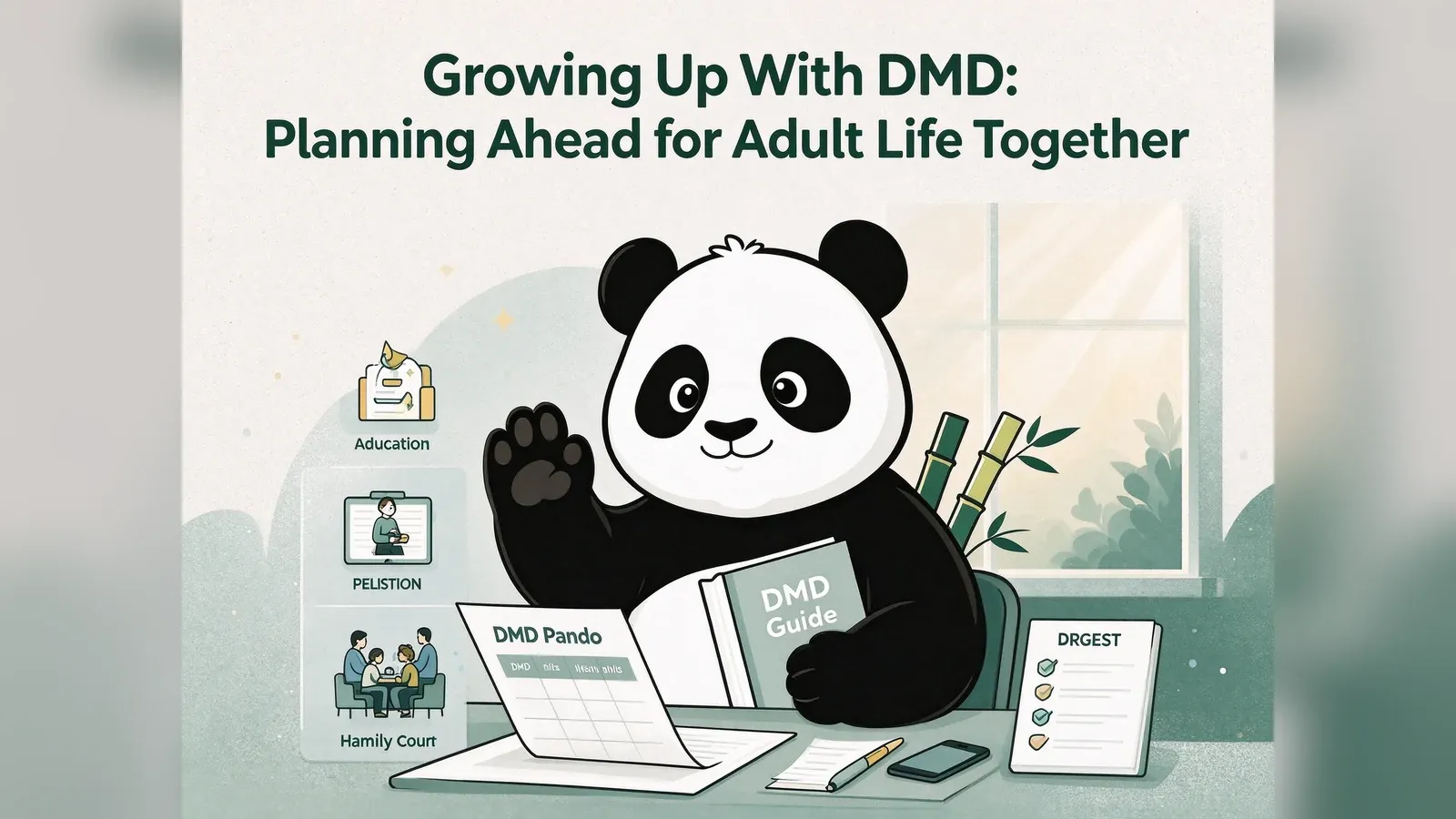
Growing Up With DMD: Planning Ahead for Adult Life Together
The short answer: this question is hard because it is genuinely new. With better care, more and more children with DMD are living into adulthood, and parents' worry has shifted from "how…
What parents ask most “He's 14. When do we move from children's services to adult services? Do adult hospitals even understand DMD?” “Can he go to university? Can he work? Can he live on his own? Who pays for a carer?” “If one day his breathing fails, do we agree to a tracheostomy and a long-term ventilator? Does that have to be talked about in advance?” “When we're old, or gone — who do we hand him to?”
The short answer: this question is hard because it is genuinely new. With better care, more and more children with DMD are living into adulthood, and parents' worry has shifted from “how long will he live” to “what will he live on, who will care for him, and what happens when I'm not here.” The paediatric team has to hand over to an adult team. School has to connect to work. Life has to move towards independence, and medical decisions have to pass, slowly, into his own hands. PPMD repeats one line: transition is not one transfer to another hospital. It is a process that starts at 13–14 and is reviewed every year. The earlier you start talking about it, the less panic there is.
What “transition” actually has to cross over
The DMD transition toolkit published by PPMD and the US CDC (in the journal Pediatrics) divides transition into four parts: health and medical care, education and employment, getting around in the community, and social life and independence. A 2025 study of 42 adults (average age 24.3) found the greatest need for help was exactly in education and employment (52.5%) and activities of daily living (57.0%). 76.1% needed social-work help with work, education support and housing, and 66.6% needed support around palliative care. And there was one finding that goes against instinct: transition needs do not shrink with age, and they do not get lighter just because someone functions a little better. Young people with more brothers and sisters were actually better prepared for transition — because there were more people supporting them.
Medical transition: ask the paediatric team early which local adult hospital, and which department, can take over. Before the handover, put his records, genetic report, medication list and equipment list into one complete handover pack. Do not wait until the last paediatric appointment to start looking.
Education and work: when choosing a subject or a career, count in physical effort, accessible buildings and whether the work can be done remotely. The strengths of young people with DMD are often in thinking and skilled work. The earlier you plan, the wider the choice.
Independent living: living on his own is not all or nothing. Personal assistants, home adaptations and assistive technology can each deliver a different degree of “independent.” Costs and application routes vary by place, so check employment support for people with disabilities, long-term care insurance and similar policies city by city.
Give the decisions back to him: as he grows up, he should be part of discussions about his own treatment. He has the right to know his condition, and the right to say no. Many parents find this the hardest part emotionally. It is also the heart of transition.
The subject nobody wants to open
If his breathing fails, should he have a tracheostomy? A long-term ventilator? How far should resuscitation go? That is an advance care plan. Parents in China generally find this, and “palliative care,” hard to accept, and easily misunderstand it as giving up treatment. It is the opposite. Talking early means recording his wishes while he is well enough to express them — instead of a family being forced, outside a resuscitation room, to make a lifelong decision in a few minutes. How you talk matters too: do not pick his worst day. Start from a concrete question, such as, “If your breathing gets worse in future, what would you want us to do?” If you cannot reach agreement, leave it, and come back to it later. Ireland published a national DMD paediatric-to-adult care pathway in November 2025. Writing transition into a system like that is a lesson China will have to learn sooner or later.
In China | Abroad
Honestly, adult DMD care is close to a blank page at present. Adult neuromuscular specialists, adult respiratory support, employment support, accessible housing and long-term care arrangements are not joined up into a system. What parents can do is prepare the medical handover pack early, get the disability certificate and every subsidy in place, and take legal advice early on guardianship and property arrangements (a will, an appointed guardian). None of it feels lucky to talk about. None of it can wait. | PPMD's transition planning starts at 13–14 and is reviewed at least once a year, covering education and work, independent living, health and social inclusion. The 2018 Lancet Neurology consensus also listed transition care as one of three new themes, discussed alongside education, employment, relationships and quality of life.
Sources for this article
PPMD transition of care through adulthood page (starting age and review rhythm): https://www.parentprojectmd.org/care/for-families/transition-of-care-through-adulthood/
Barak et al., PLOS ONE 2025 (transition needs data for adult patients): https://ouci.dntb.gov.ua/works/73ZR3gQ9/
The Lancet Neurology 2018 consensus (transition as a theme, via Action Duchenne summary): https://www.actionduchenne.org/revised-standards-of-care-for-duchenne-muscular-dystrophy/
What Is Still Unsettled
Every place in these 10 articles where something is not settled is flagged in the text. Here they are again, in one place, so you do not make a decision on out-of-date news:
Is vamorolone covered by medical insurance? As of the check on 11 November 2026, all that is confirmed is that it passed the format review for the 2025 national insurance drug list and entered negotiation. Inclusion, and the final price, are not confirmed.
Domestic trial status changes fast. For the latest on BBM-D101 and HG302, go by trial registries and the trial centres' newest announcements — not by any article, including this one.
“About 70,000 people with DMD in China”: this figure appears often in industry reports, but no national registry data backs it. Treat it as an estimate only.
The CORD cost figures (about ¥200,000 a year; medical spending over 60% of income in more than 70% of families) come from a search summary. The original page could not be opened for checking this time, so bear that in mind when quoting them.
Discount company-released long-term data. The vamorolone fracture and height figures, and givinostat's long-term follow-up, come from company press releases or conference reports, not peer-reviewed papers.
On the name of SAT-3247: forazapadin is the generic name for SAT-3247, as stated by Satellos itself.
Compiled on 11 November 2026. Sources include PPMD, the World Duchenne Organization, Treat-NMD, Duchenne UK, the MDA, the Lancet Neurology DMD care consensus, and public reports from Chinese bodies and media including CORD and the Rare Disease Information Network. Each article lists its own sources. The PPMD newborn screening page and the Chugai launch release from Japan were checked directly on the day; the rest are that day's search results. For prices and policies, always go by the latest official announcement.
This document is general health information, not medical advice. Decisions about your child's medication, rehabilitation and trial participation should be made together with his doctor.