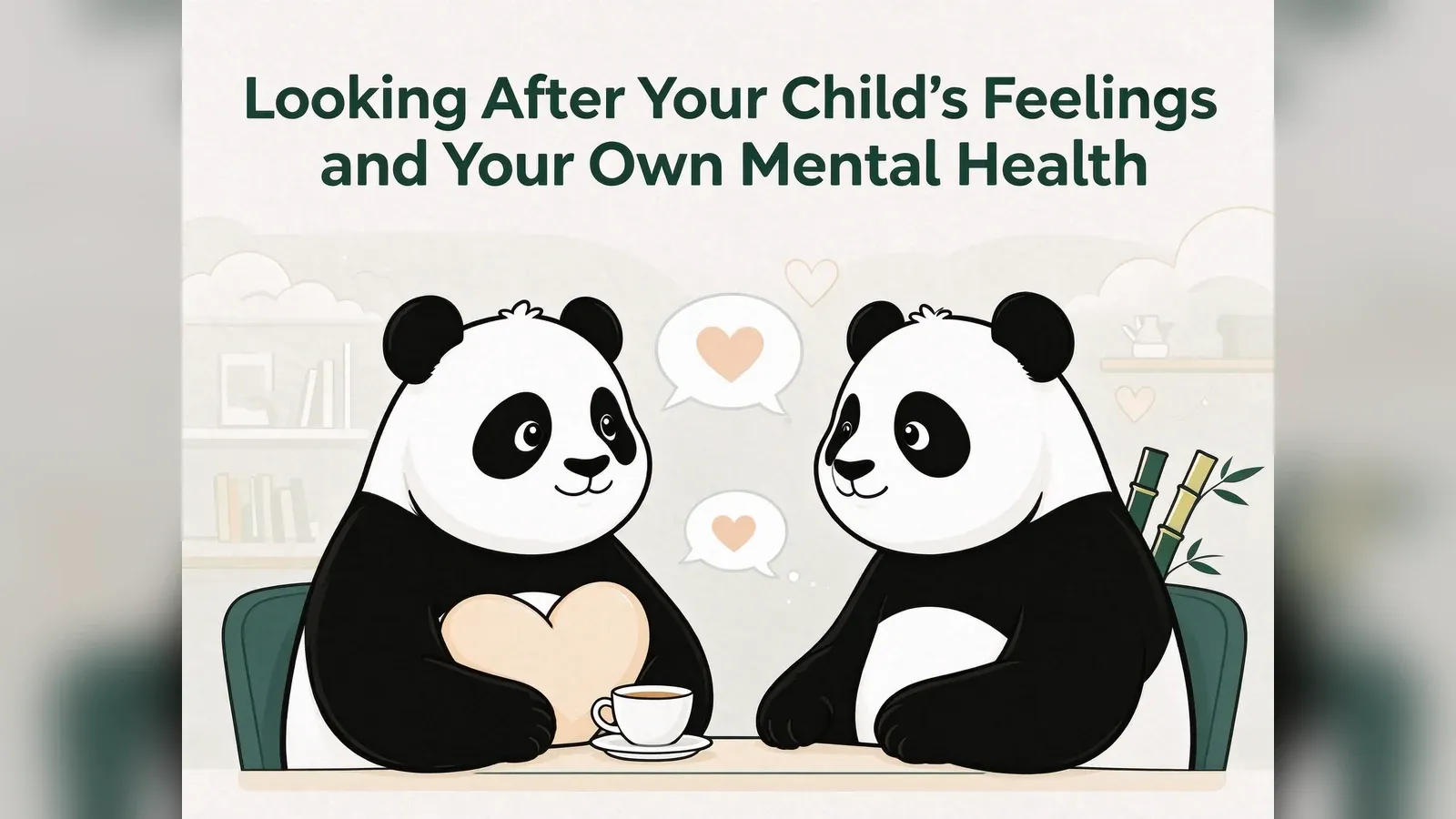
Looking After Your Child's Feelings and Your Own Mental Health
The short answer: mental health problems in DMD families are not a few people being fragile. They are the norm for most families — most of whom have never asked for help. A University of…
What parents ask most “He can't concentrate and can't sit still. Is that DMD itself, or a side effect of the steroids?” “He says, ‘Why am I different from everyone else?’ and asks, ‘Am I going to die?’ How am I supposed to answer that?” “I can't sleep at night and I want to cry all day. Am I depressed? We argue about treatment all the time, and our other child feels left out. What do we do?” “Are there parent support groups? What is the point of joining a patient organisation, really?”
The short answer: mental health problems in DMD families are not a few people being fragile. They are the norm for most families — most of whom have never asked for help. A University of Pittsburgh survey of 230 parents gave blunt numbers. At diagnosis, 94.78% of parents had depressive symptoms of some degree, and 42.6% of them were moderate to severe. 58.26% had moderate to severe anxiety. Later, as the disease progressed, 91.63% still had depressive symptoms. And most of them had never used therapy, psychiatry or a support group — usually because they felt they did not need it, had no money, had no time, or did not know where to go. If you read nothing else in this article, take this: asking for help is neither shameful nor a luxury.
The child's side: DMD is not only about muscle
Dystrophin is also expressed in the brain, so boys with DMD have clearly higher rates of neuropsychological conditions than other children. A meta-analysis cited at PPMD's 2026 conference (Nature Communications, 2025) gave these figures: attention deficit hyperactivity disorder (ADHD) about 18%, anxiety about 24%, depression about 11%, autism about 7%, obsessive-compulsive disorder about 12%, intellectual disability about 20%–25%, and learning difficulties in about a third. In the European BIND study (238 children aged 5–17), 21% met criteria for at least one DSM-5 diagnosis. So if he cannot sit still, learns slowly, or his mood swings, do not rush to call it “being naughty,” and do not blame it all on steroids either. If an assessment is needed, get one. Psychology and developmental-behavioural paediatrics are proper places to go.
Children will ask, “Am I going to die?” and “What will happen when I grow up?” There is no dodging those questions. The shared experience of guidelines and patient organisations abroad is this: answer to the extent the child asks. Do not add more than he asked for, and do not invent a lie that everything is fine. Children can feel an adult avoiding the subject. A calm, honest answer is, in fact, where their sense of safety comes from.
The parents' side: look after the person doing the caring
A Polish study of 202 caregivers (Orphanet Journal of Rare Diseases, 2024) found quality of life significantly below the national average on every dimension, with financial situation the strongest predictor of both quality of life and care burden — which ties straight back to the money problem in Article 4. An Australian survey in 2025 also found depressive symptoms common among parents whether or not their child used a ventilator. In other words, burnout is not a stage you get through and leave behind. It is a long-term state, and it needs long-term support: treat mental health screening as a routine review item, like the heart scan and lung function; rotate care within the family where you can, so the main carer gets real rest (respite); and remember that most arguments between partners are not about the relationship. They are about two people who are both at their limit.
In China, where do you find people like you?
The National DMD Patient Families Alliance: founded jointly by CORD and parents on 7 September 2024, with 28 regional working groups. Finding your local group is the most practical first step.
The Beijing Zhiai DMD Care Center has more than 10,000 members. There are also parent organisations such as “Dongli Baobei” in Shenzhen and the national YiJia MD family association.
The real value of a support group is not just information. It is “someone understands.” News of new drugs, which hospital and which doctor, how to apply for chronic-disease status — someone in the group has usually walked that road before you. But a group's experience with medication is no substitute for a doctor. Anything about changing or stopping a drug goes back to the hospital to be confirmed.
If things are already bad If you have had more than two weeks of poor sleep, a clear change in appetite, no interest in anything, repeated crying, or thoughts of harming yourself, go directly to the psychology or psychiatry department of a general hospital. That is proper medical care, in exactly the same way as taking your child to neurology. If there is an immediate risk of self-harm, call 110 at once, or go to emergency care.
Sources for this article
University of Pittsburgh parent mental health survey (n=230, depression and anxiety rates): http://d-scholarship.pitt.edu/41375/
PPMD 2026 conference, brain and mental health session (comorbidity rates in children): https://www.parentprojectmd.org/wp-content/uploads/2026/07/D3-P03-Natalie_natalie_truba_2026-PPMD-fam-conf-TRUBA_-brain-session-v2.pdf
Polish caregiver quality-of-life study (Orphanet Journal of Rare Diseases, 2024): https://d-nb.info/1356430589/34
CORD / Rare Disease Information Network (founding of the National