What Treatment Really Costs and How Families Manage to Pay
The short answer: DMD is expensive not because of any single injection, but because it is a bill for life. Research by the Chinese Organization for Rare Disorders (CORD) puts it plainly.…
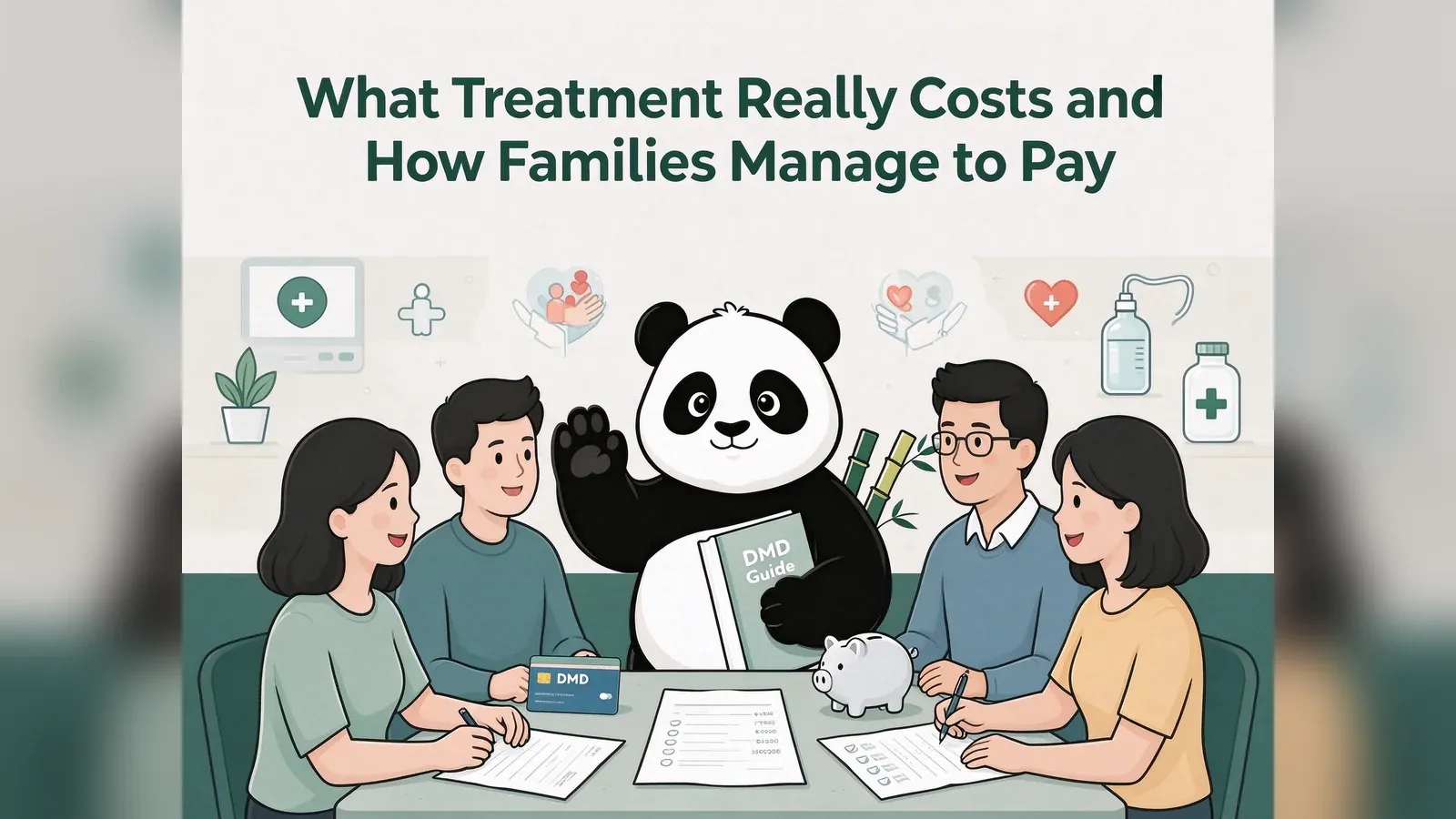
What parents ask most “How much is vamorolone a month? If insurance covers it, how much comes back? Can we register DMD as a chronic outpatient condition in our province?” “Is rehab reimbursed? What about a wheelchair, a ventilator, a standing frame?” “We bought critical-illness insurance before he was diagnosed. The insurer says no biopsy, no payout. What can we do?” “Once he can't walk, one of us has to stay home full time. Is there a care allowance? How do we get a disability certificate?”
The short answer: DMD is expensive not because of any single injection, but because it is a bill for life. Research by the Chinese Organization for Rare Disorders (CORD) puts it plainly. After a child loses the ability to walk, 61.3% of families need one parent providing full-time care. Families spend about ¥200,000 a year on treatment, rehabilitation and care. And in more than 70% of families, medical spending takes over 60% of total household income. Some families do not stop proper treatment because they do not want it. They stop because they cannot carry it. By the end of this article, you should at least know which costs the system is supposed to help you share, so you are not quietly carrying them all yourself.
Do these things first
Outpatient chronic /1 million payout): https://m.163.com/dy/article/KTKD5JMJ0514R9KQ.html quoted from a search summary; the original page could not be opened for checking this time, so treat the figures with care: https://www.raredisease.cn/News/Info/24293Rare Disease Information Network patient story (one family's drug costs): http://www.raredisease.cn/Story/Info/24242Shandong Provincial Healthcare Security Administration (DMD outpatient chronic disease status and triple protection): http://ybj.shandong.gov.cn/art/2025/4/15/art_113623_10316065.htmlNetEase News (Beijing critical-illness case, ¥200,000 a year, share of household income) — some are narrower than the FDA indication. Japan caps out-of-pocket costs through its high-cost medical expense system (see Article 1). In Europe and the UK, drugs are assessed one by one; givinostat has public reimbursement in Italy, Germany, Spain and Scotland.Sources for this articleCORD survey (61.3% full-time care, about ¥ see Article 3). | Elevidys carries a $3.2 million list price in the US, but most families pay far less themselves. Prior authorisation is required, the manufacturer offers co-pay assistance (not available to government insurance), and state Medicaid coverage rules vary — and it is the parents who have to run around, ask and apply for every piece themselves. Vamorolone is not yet on the national medical insurance list (it was in negotiation in 2025; the result is unconfirmed — and know where you need to ask for help, early.In China | AbroadSupport is fragmented: chronic-disease outpatient cover, critical-illness insurance, medical assistance, disability subsidies and charity aid. Each piece is small. Put together, they just about hold —20,000 a month, and it still felt like a drop in the ocean. Their application for local assistance was refused because of a payslip. This is not an unusually tragic case. It is everyday life for many DMD families. So budget by the year, not by the month: drugs, plus rehabilitation, plus equipment, plus check-ups, plus the income lost when one parent stops work. Add it all up, and only then do you see the real gap —300,000 a year for that one item alone. The household brought in over ¥ over ¥22,480 a bottle, four bottles a quarter —10,000 a month in drug costs. Diagnosis by genetic testing is today's medical consensus. "No biopsy" should not be a reason to refuse a claim. If a claim is refused, talk to a lawyer before you walk away.Patient assistance and charity programmes. New drugs often come with assistance programmes around launch. Ask the drug company's patient hotline and your local patient organisation. That is more reliable than rumour in a chat group.One family's real ledger The Rare Disease Information Network recorded one family like this: a drug at ¥1 million, plus waiver of later premiums. With that money, the parents moved their child to a drug with fewer side effects, at over ¥200,000 a year, that is a drop in the bucket, but it is better than nothing. Rules differ completely from province to province. Step one is to call or visit your local medical insurance bureau and ask: what is DMD called as a disease category here, how do we apply, and what documents are needed?Disability certificate and the "two subsidies." The living allowance for people with disabilities, and the care subsidy for people with severe disabilities, are real help for families providing full-time care. Apply with the disability certificate. Standards vary by place.Do not give up on commercial insurance too easily. In one Beijing case, an insurer refused a critical-illness claim because no muscle biopsy had been done and no assessment of six daily-living skills had been provided. The parents sued, and the court found for them at both hearings: a payout of ¥6,000 for resident insurance. Against roughly ¥7,000 for employee insurance and ¥ but the annual limits are low: ¥ can connect to critical-illness insurance, forming "triple protection": medical insurance, critical-illness insurance and medical assistance. From 1 January 2026, Jiangsu includes muscular dystrophy in its outpatient special diseases, with no deductible and 70% reimbursement — including amounts below the deductible and above the cap — special disease status. This is the most practical item on the list. Since 2022, Shandong—